How to Beat Competitors in AI Search: A 2026 Playbook
Your competitor may not have a better product. They might just be easier for an AI to find and check. Ask ChatGPT which tool to buy in your category and their name comes back. Yours doesn't. Your Google ranking won't explain that gap, and it was never built to.
On this page
Start with the questions buyers ask before they have chosen a vendor. Run the same set of questions, record which brands appear, then open the sources cited around those answers. The goal is not to guess at an AI ranking formula. It is to find the specific content, evidence or access gaps where your competitors currently have an advantage.
This playbook shows how to benchmark that gap, investigate why a competitor is winning, decide what is actually worth fixing, and measure whether the gap starts to close.
Everything in this playbook can be done by hand, one question at a time. If you'd rather not, Xtrusio runs the same pass across ChatGPT, Gemini, Claude and AI Overviews and keeps every cycle comparable to the last.
Benchmark before you change anything
You can't overtake anyone until you know where the gap sits. It is tempting to skip this part and start publishing immediately.
The usual first move is to type your own company name into ChatGPT and read what comes back. That isn't an audit. Somebody who already knows your name isn't the buyer you're trying to win.
What matters is the unbranded question, the one somebody asks before they've decided who to call. Build a fixed set of those, run them across the platforms your market uses, and write down which brands appear, where they sit in the answer and which sources the answer cites. If the mechanics are new to you, start with what ranking on ChatGPT actually means.
Pull questions from across the buying process. A cloud security company might run something like this:
- How can a company reduce cloud security risks?
- What are the best cloud security platforms?
- Which cloud security tools suit enterprise teams?
- Who competes with [competitor] on cloud posture management?
- Which cloud security vendors serve banks in the Gulf?
Then record what comes back. These are the columns worth keeping:
Metric | What it tells you |
|---|---|
Brand mention rate | How often your company gets named at all |
Competitor mention rate | How often each rival gets named |
First-mention rate | How often you are introduced before them |
Citation presence | Whether your own pages are among the cited sources |
Source diversity | How many separate credible domains support you |
Message accuracy | Whether the description of your product is right |
Sentiment | Whether you are framed well, neutrally or badly |
Question coverage | Which stages and use cases you turn up for |
Illustrative structure. Pick the columns that match how your buyers choose, then keep them fixed once you start.
One number isn't a benchmark >Rolling all of this into a single AI score feels tidy, but it hides the part you need. If you can't explain how the number is built, you can't act on it either. A raw split, where you turn up in far fewer questions than a rival does, at least gives you something to go and investigate.
Work out why they are winning
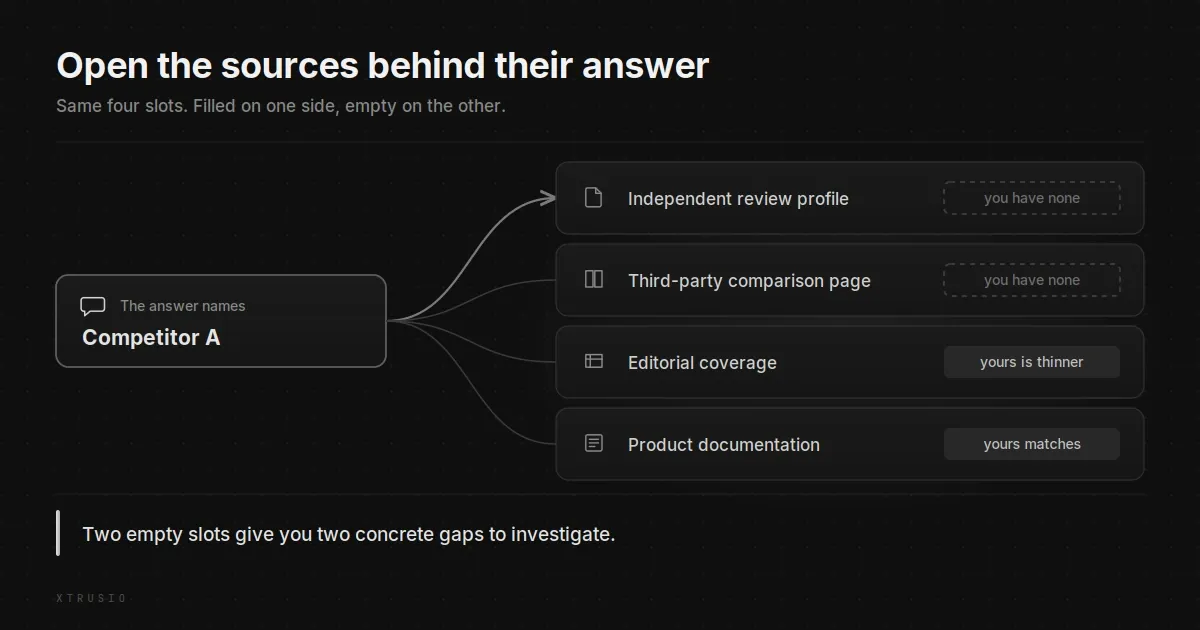
Knowing where you lose is half of it. The other half is opening the sources sitting behind their answer.
Do not assume domain authority explains the whole gap. AI answers pull from all sorts of places. Company sites, news coverage, review platforms, comparison pages, forums, research, directories.
OpenAI says ChatGPT Search ranks results on several factors meant to surface relevant, reliable information. It also says top placement isn't guaranteed. And before it answers, ChatGPT may rewrite what somebody typed into tighter searches. Google does something close to this in its own AI features, where one question can fan out into several related searches.
So a single buyer question can expose more than one hole. Take this one:
What is the best CRM for a 200-person B2B SaaS company?
To answer that well, a system needs more than one thing. Something on CRM platforms. Something on B2B use cases, company size, integrations, pricing, migration, and what customers say once they're live. If a rival covers most of that and you have one page called CRM Software, the result stops being a mystery.
Run a source-gap analysis
For every question where a rival appears and you do not, open the citations and work through six things:
- Which domains support them?
- Are those domains theirs, or somebody else's?
- What claim is each page backing up?
- Is it a review, a comparison page, a doc or a news piece?
- Do you have an equivalent?
- If you do, is yours thinner, vaguer or less trusted?
Often, the investigation leads to something much more concrete than an 'AI problem': missing comparison content, weak customer proof, stale documentation, no independent coverage or a page the crawler cannot reach.
Evidence beats claims
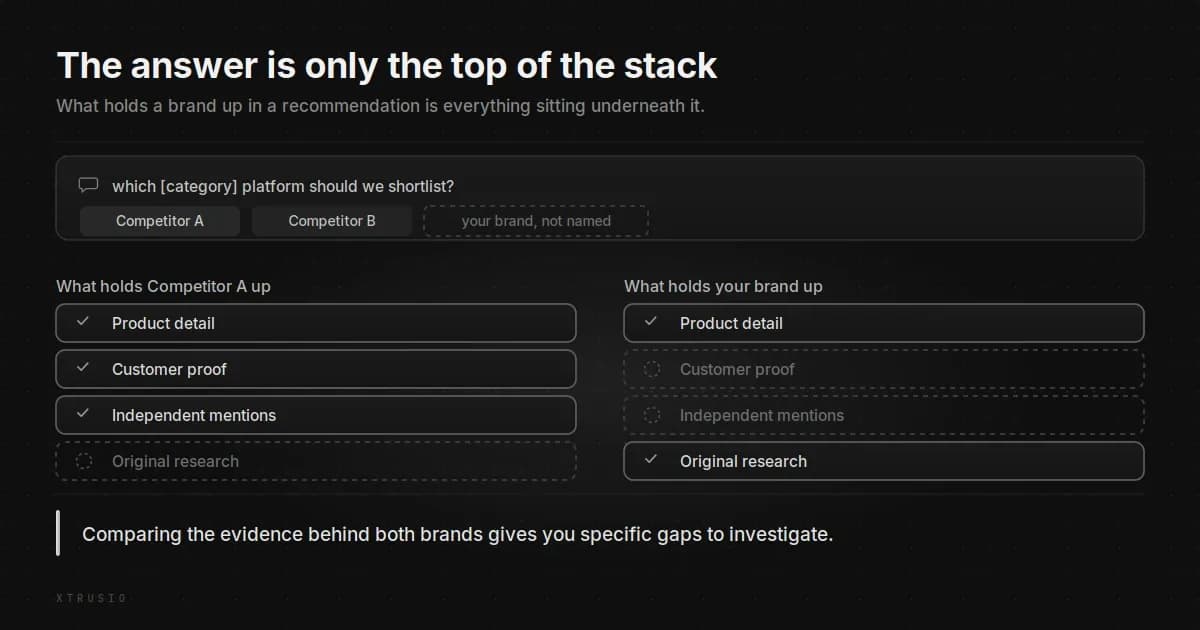
Two companies can sell the same thing. The one that can be checked is easier to recommend.
Picture two HR software companies. The first says it offers a powerful all-in-one HR solution for modern businesses. The second publishes a page built for companies over 500 staff. Rollout timelines. Integration docs. Three customer stories with real numbers in them. A security overview. Its own staffing survey.
Nothing the first company says is wrong. There's just nothing in it to check.
Four kinds of evidence are worth comparing. Which matters most will depend on the question a buyer is asking.
Product detail
Say what it does, who it's for, what it connects to, roughly what it costs and where it stops. Limitations included. Vague copy gives nothing to work with, and it gives buyers nothing either.
Customer proof
A case study showing a 600-person company cutting contract review from nine days to two gives a reader something concrete to evaluate. 'Trusted by leading enterprises' gives them far less to check.
Independent mentions
Industry press, analysts, credible directories, trade bodies, partner sites, real customer reviews. Do not chase mention volume on its own. A smaller number of relevant, credible references can be more useful than a large batch of low-value placements.
Your own research
A benchmark study. A customer survey. Anonymised product data. A pricing breakdown. This is the one a rival can't copy by Friday. Google's people-first content guidance asks for original material rather than a repackage of what's already out there, and that holds well beyond Google. Publish something new and other people have a reason to cite you.
Close the gaps question by question
A keyword gap report tells you what you don't rank for. It won't tell you which buyer questions you can't answer.
The traditional version reads: they rank for 1,400 keywords we do not. Useful for SEO. For AI search you want a different question. Which buyer questions can they answer convincingly, and you can't?
Take your important prompts and map each one to the evidence it needs. Say the question is what are the best project management tools for agencies. That wants an agency page. Feature docs. Client collaboration detail. Pricing. At least one agency case study. A comparison against the obvious alternatives, and some presence on review sites.
Then put your coverage next to theirs:
Evidence | Your brand | Competitor |
|---|---|---|
Agency landing page | Weak | Strong |
Feature documentation | Strong | Strong |
Agency case studies | None | Four |
Comparison pages | One | Six |
Independent reviews | Moderate | Strong |
Original research | Strong | None |
Illustrative. What you are reading here is the shape of the gap, not a score.
Now the job is smaller than it looked. You might not need thirty blog posts. You might need two case studies and three comparison pages.
One trap to avoid: don't build a page for every prompt variation. Google warns against spinning up large numbers of pages to chase every possible query, and asks for people-first content instead. A single solid enterprise CRM migration guide can cover timelines, risks, data mapping, Salesforce, HubSpot, costs and stakeholder planning. Seven shallow posts saying nearly the same thing cover less than that.
Skip the shortcuts >There's no special AI schema to add and no file you can drop at your root to force your way in. Google's guidance for its AI features says as much and points at ordinary search fundamentals instead. Structured data still earns its place when it describes what is visibly on the page. It won't stand in for evidence you haven't built.
Fix access before chasing mentions
Content nobody can reach can't compete. This is cheap to check and easy to miss.
For ChatGPT, OpenAI tells publishers to allow OAI-SearchBot and to make sure their host or CDN isn't blocking its published crawler documentation. Robots.txt is only one layer. A CDN, WAF or bot-management rule can still block a crawler even when robots.txt allows it.
For Google's AI features the requirements are the ordinary ones. Google says there's nothing special to do beyond being indexed, being eligible to appear with a snippet and meeting the existing Search requirements.
Work through this on your competitor-critical pages first, not the whole site:
- robots.txt rules, and any accidental noindex
- CDN, WAF or bot-management layers returning 403s
- canonical tags pointing somewhere unexpected
- JavaScript rendering and broken redirects
- internal links into the pages that matter
- anything important sitting behind a login
Buying twenty more articles while your best comparison page hands back a 403 is an expensive way to stand still.
Check whether you are catching up
Same questions, same schedule. Change the questions and you've thrown the baseline away.
The loop is short. Ask, record, compare, improve, repeat. What you are watching for is movement across cycles, not a screenshot from a good day.
Track how often you get named, how often each rival does, how often you come first, whether your own pages end up cited and how many separate domains support you. Then read the trend rather than any single run.
Use platform data where you can
In February 2026 Microsoft added an AI Performance report to Bing Webmaster Tools. It's in public preview. It covers citation activity across supported AI experiences, which pages got cited, the queries behind them, and how visibility moves over time. Microsoft is clear that a citation count is neither a ranking nor a placement. OpenAI says publishers who allow OAI-SearchBot can also see ChatGPT referral traffic in their analytics. Use both next to your own prompt testing, not instead of it.
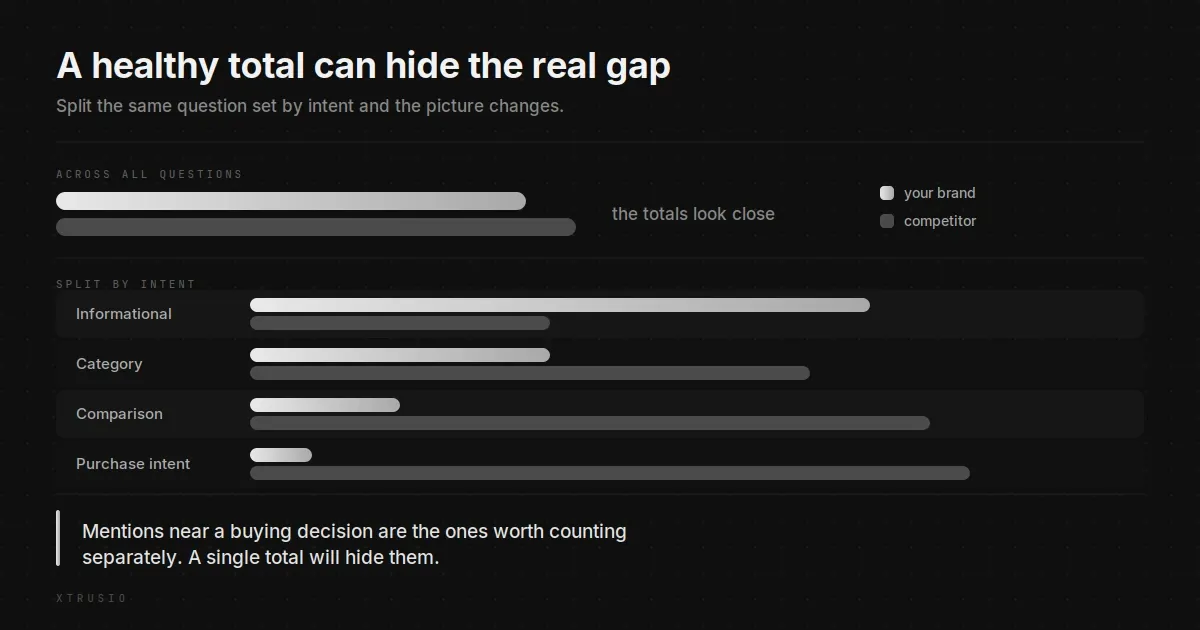
Count commercial questions on their own
Not every mention is worth the same. Turning up for what is project management is visibility. Turning up for best project management platform for a 300-person agency sits much closer to money. Split your set into informational, category, comparison, alternative and purchase-intent questions.
Do that and a comfortable total can come apart in your hands. Plenty of brands look healthy on volume while a rival owns everything within reach of a decision.
The overtaking sequence
Don't open by publishing more than them. Open with the questions they win and you do not.
For each of those questions, in this order:
- open the sources holding their answer up
- work out what evidence is missing on your side
- improve the page that should have covered it, and write a new one only if there is a real gap
- go and earn the independent validation
- confirm the whole thing is reachable
- rerun the same benchmark
That's a narrower job than beating the internet. You are trying to become the better-supported answer to a defined set of buyer questions. Repeat the same benchmark over time. Once you have enough comparable runs, you can see whether the gap is narrowing, staying flat or getting worse.
Find out who is taking the slots you want
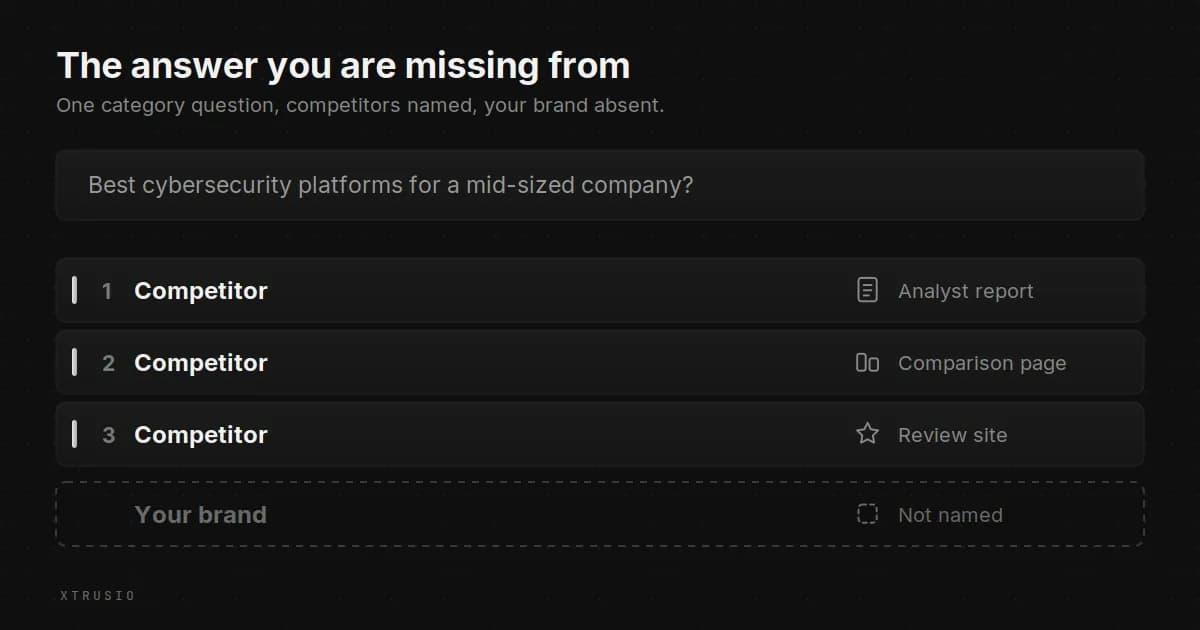
Most tools score you on searches for your own name. Xtrusio works the other way round. It asks the category questions where nobody has named you yet, then reports which brands came back, which pages fed the answer and how far you sat from the top. Engines covered: ChatGPT, Gemini, Claude and AI Overviews. The waitlist is open while the product is being built.
Sources: OpenAI, Overview of OpenAI crawlers, for OAI-SearchBot and the published crawler IP ranges. OpenAI's ChatGPT Search documentation, for ranking factors, query rewriting and the absence of guaranteed placement. Google Search Central, AI features and your website, for query fan-out, technical eligibility and the advice against AI-specific files, and Creating helpful, reliable, people-first content. Microsoft Bing Webmaster Tools, for the AI Performance report and its note that citation activity doesn't represent ranking, authority or placement. Product behaviour and documentation change, so confirm against the live sources rather than this page.
Frequently asked questions
Can a company guarantee it will rank above competitors in ChatGPT?
No. OpenAI says ChatGPT Search uses several factors meant to surface relevant, reliable information, and that top placement isn't guaranteed. Anyone selling you a fixed position is selling something they can't deliver. The honest goal is to improve your odds of being picked, then check whether the odds moved.
How long does it take to beat a competitor in AI search?
Nobody can give you a reliable number, and a confident one should worry you. It depends on how big the gap is, what evidence already exists, whether your pages can be reached, and how quickly new information gets picked up. Judge it over repeated benchmark cycles, not against a promise like ranking in ChatGPT within 30 days.
Should we publish more articles than our competitors?
Not necessarily. Fifty generic posts can do less than five pages that close real buyer question gaps. Google's people-first guidance asks for original information, research and substantial value rather than content built to game rankings. Coverage quality beats page count.
Are backlinks still important for AI search?
Links and third-party mentions help people and search systems find and check information, so they still matter. Just don't boil AI visibility down to a link count. What counts is whether credible sources really tie your brand to the category or use case you want.
Can we beat a larger competitor with a smaller domain?
Potentially, yes, especially for narrower questions where your company has stronger relevant evidence. Domain size alone does not guarantee inclusion in an AI answer, but neither does having a smaller site guarantee you can outrank a larger competitor. A small CRM built for recruitment agencies can win best CRM for recruitment agencies while a much larger rival owns the broad category.
Topics
- beat competitors in AI search
- AI search competitor analysis
- AI visibility benchmarking
- generative engine optimisation
Xtrusio
AI visibility research
See what AI says about your brand
Access requests are temporarily paused while the new platform is prepared.
View access updateKeep reading
AI Search Optimization Agency: What to Expect, What It Costs, and How to Choose One in 2026
Looking for an AI search optimization agency? Learn what the service should include, what GEO costs in 2026, and how to choose the right partner for your brand.
How Can CLM Marketers Compete with Gartner, G2 and Capterra?
A practical organic strategy for CLM marketing teams to win narrow buyer decisions with first-party evidence instead of copying software directories.